Research
Working Papers
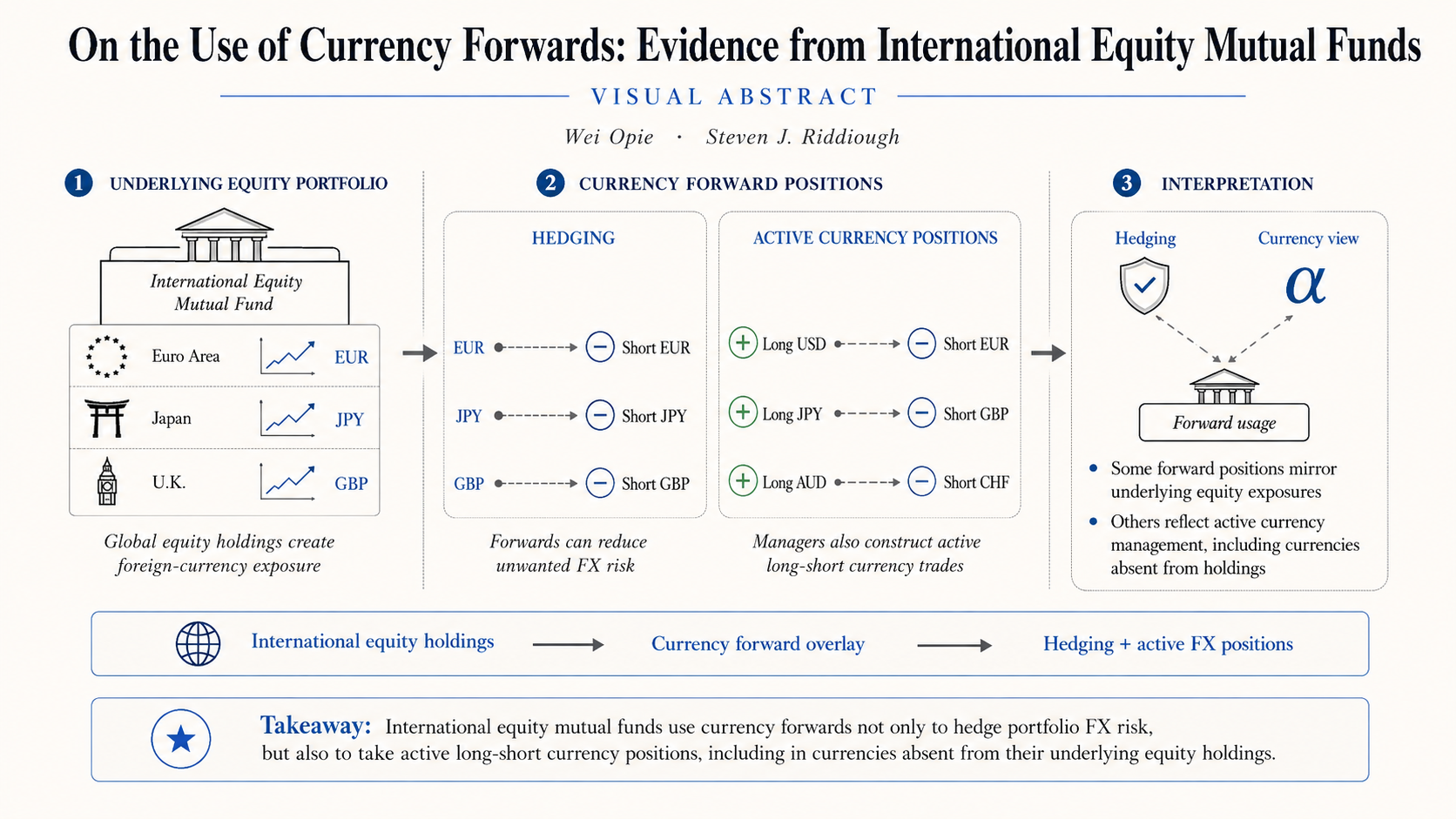
On the Use of Currency Forwards: Evidence from International Equity Mutual Funds
with Wei Opie (Deakin)
Latest version: July 2026 · Download
Winner of the 2023 Hillsdale Investment Management - CFA Society Toronto Research Award
Winner of the 2023 FIRN Asset Management Meeting Best Paper Award.
Abstract. Using a novel dataset of currency forward positions, we study how U.S. international equity mutual funds manage currency exposure. Forward use is limited, concentrated, and often difficult to reconcile with classical variance minimization. Instead, managers construct long-short currency portfolios consistent with a speculative motive, including currencies not represented in the underlying equity portfolio. Forward positions are related to currency return and risk signals, suggesting active currency management rather than simple hedging. These positions modestly improve fund performance, but gains fall short of those implied by simple carry-based currency portfolios. Liquidity constraints, margin requirements, and benchmark incentives help explain limited forward use.
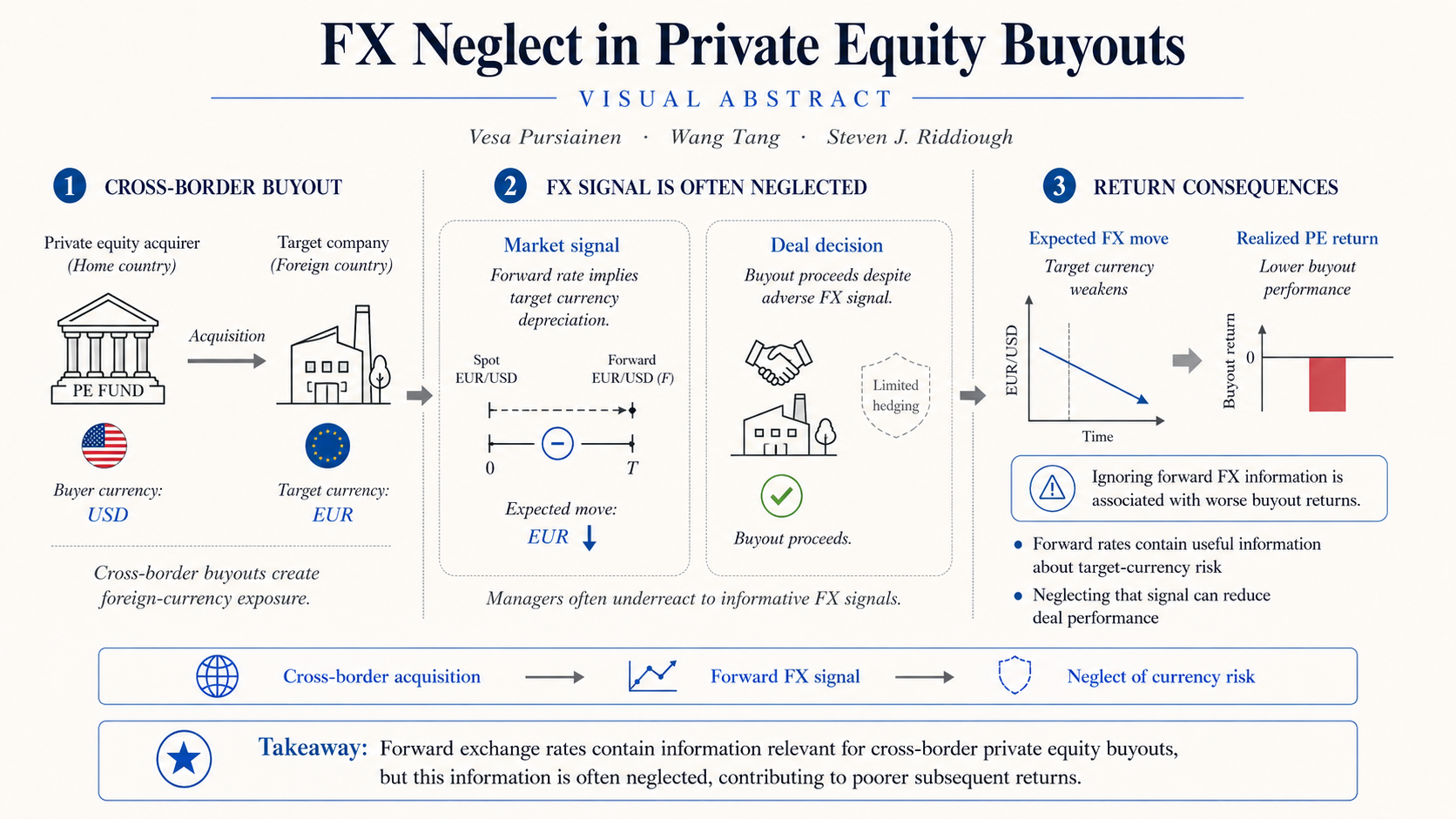
FX Neglect in Private Equity Buyouts
with Vesa Pursiainen (St. Gallen) and Wang Tang (St. Gallen)
Latest version: May 2026 · Download
Abstract. Our evidence suggests that international private equity (PE) funds misallocate capital by failing to account for predictable foreign exchange (FX) movements. Ex-ante observable forward FX rates predict realized FX changes and fund-level investment returns. Furthermore, PE funds are more likely to make acquisitions when forward FX rates imply the target currency will depreciate. The effects become weaker for PE funds dealing more in foreign currencies and that previously experienced FX losses. They disappear in placebo tests in which domestic-only PE funds are assigned an expected FX return. Similar results are obtained using real exchange rates to capture expected FX movements.
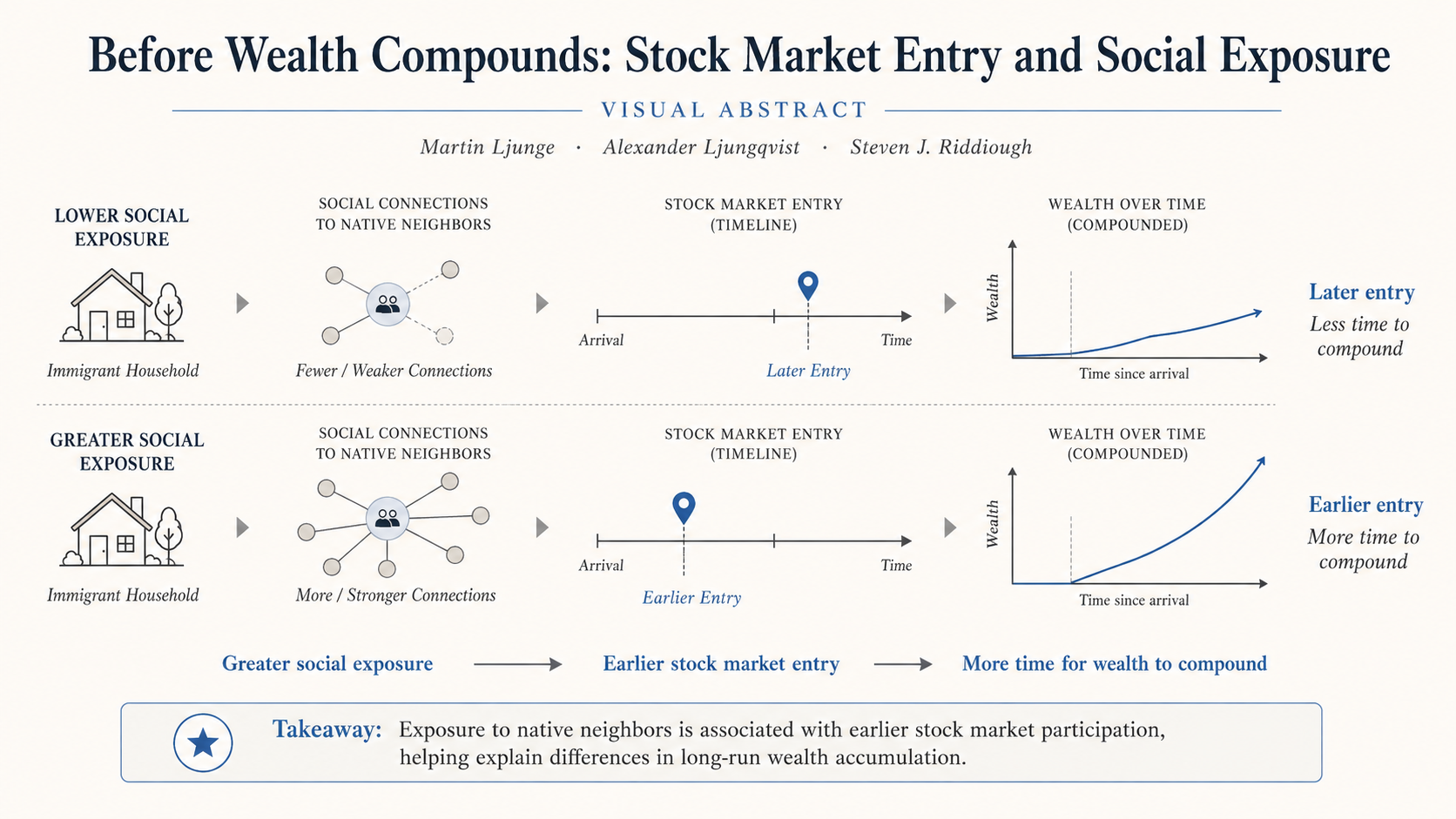
Before Wealth Compounds: Stock Market Entry and Social Exposure
with Martin Ljunge (IFN) and Alexander Ljungqvist (SSE)
Latest version: August 2026 · Download
Abstract. Financial inequality is not only about who has wealth today, but also about who gains timely access to wealth-generating assets. We study stock market entry as a first barrier to cumulative returns and ask whether local social exposure helps households overcome that barrier. Using Swedish administrative data on immigrants, we find that exposure to native residents accelerates entry into equity markets. The effect is strongest for immigrants from low-trust countries, who face higher trust-related barriers, and disappears in residential blocks where natives are less tolerant toward immigrants. The evidence is consistent with exposure to native residents facilitating local knowledge and language acquisition, building trust in institutions, and spreading participation norms. Overcoming financial exclusion therefore depends not only on the barriers faced by disadvantaged households, but also on the openness of advantaged peers.
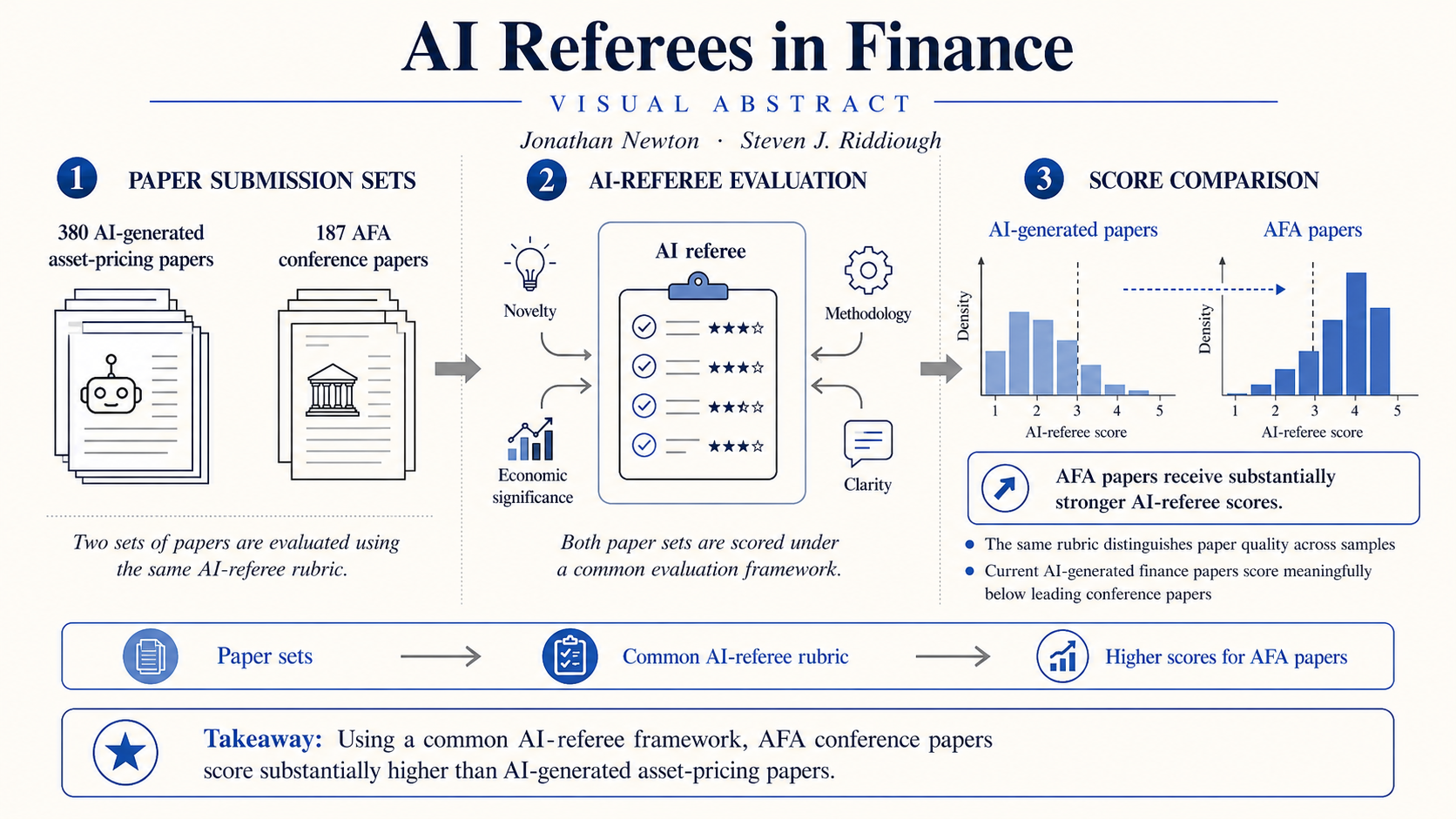
AI Referees in Finance
with Jonathan Newton (Kyoto)
Latest version: March 2026 · Download
Abstract. We study whether rubric-guided large language models can assist editorial screening in finance. We design a pre-specified AI referee and apply it to two corpora, evaluating each manuscript independently in a separate model session: 380 industrialized AI-generated empirical asset-pricing papers and 187 papers from the 2026 American Finance Association program. The referee sharply separates the two groups. AI-generated papers receive uniformly low scores and are overwhelmingly judged unpublishable, whereas AFA papers score higher and cluster in publishable tiers. Scores are stable across repeated evaluations and appear largely insensitive to prompt injection and author affiliations. Rubric-guided AI referees thus appear to offer useful editorial screening capabilities, but cannot replace expert human judgment.
Publications
The End of Crisis Insurance? Reassessing the U.S. Dollar and the Case for Currency Hedging
with Wei Opie (Deakin)
Latest version: July 2026 · Download
Journal of Portfolio Management, forthcoming
Abstract. The U.S. dollar has historically provided crisis insurance for many non-U.S. investors, reducing the need to hedge currency exposure on U.S. equity holdings. We argue that this insurance may weaken as shocks increasingly originate in the United States and as the dollar’s global role erodes. To assess the impact of this emerging risk, we undertake a scenario analysis in which we estimate minimum-variance hedge ratios under alternative crisis-state correlations that remove the dollar’s traditional insurance role. We show the effects on hedge ratios are economically large, especially for risk-sensitive commodity currencies. The findings have important implications for investment managers, including the need to evaluate hedging policies under scenarios in which historical correlations break down and dollar crisis insurance disappears.
Currency Speculation
with Pasquale Della Corte (Imperial)
Latest version: July 2026 · Download
Annual Review of Financial Economics, forthcoming
Abstract. Over the past two decades, a growing body of research has documented profitable currency investment strategies. Beginning with the carry trade, the literature has expanded in multiple directions, uncovering diverse sources of excess return predictability linked to prices, trading volumes, and economic fundamentals. This article first reviews this burgeoning literature and provides a framework to organize its key strands for both academics and practitioners. We then turn to the often-overlooked issue of sample selection. Much of the existing work adopts an ad hoc approach to defining the currency universe. We show that strategy performance varies considerably across different currency subsamples. In particular, restricting the sample to countries with open capital accounts and liquid, floating currencies produces substantially weaker returns than when all currencies are included. Nonetheless, we find that combining strategies—regardless of the sample—yields improved and broadly comparable investment performance.
Cross-Border M&A Flows, Economic Growth, and Foreign Exchange Rates
with Jodie Zhang (QUT)
Latest version: July 2025 · Download
Review of Financial Studies, forthcoming
Abstract. We extract information about future economic conditions from firms' cross-border merger and acquisition announcements, and show it predicts changes in relative economic growth rates and foreign exchange rate returns. We find the predictability is driven by the acquisition decisions of domestic firms, which signal turning points in local economic growth. The findings are motivated via a simple model of exchange rate determination with heterogeneous expectations and support the theorized relationship between foreign exchange rates and macroeconomic fundamentals. The results provide new tools for policymakers seeking to predict economic activity and offer global investors a novel source of portfolio diversification.
Non-Standard Errors
with 300+ co-authors
Latest version: October 2024 · Download
Journal of Finance
Abstract. In statistics, samples are drawn from a population in a data-generating process (DGP). Standard errors measure the uncertainty in estimates of population parameters. In science, evidence is generated to test hypotheses in an evidence-generating process (EGP). We claim that EGP variation across researchers adds uncertainty: Non-standard errors (NSEs). We study NSEs by letting 164 teams test the same hypotheses on the same data. NSEs turn out to be sizable, but smaller for better reproducible or higher rated research. Adding peer-review stages reduces NSEs. We further find that this type of uncertainty is underestimated by participants.
Foreign Exchange Volume
with Giovanni Cespa (Bayes), Antonio Gargano (Houston) and Lucio Sarno (Cambridge)
Latest version: May 2021 · Download
Review of Financial Studies
Abstract. We investigate the information contained in foreign exchange (FX) volume using a novel dataset from the over-the-counter market. We find that volume helps predict next day currency returns and is economically valuable for currency investors. Predictability implies a stronger currency return reversal for currency pairs with abnormally low volume today, and is driven by the component of FX volume unrelated to volatility, illiquidity, and order flow. We rationalize these findings via a simple model of exchange rate determination, in which volume helps reveal the degree of asymmetric information in currency markets. Testing this prediction shows that asymmetric information is uniform across currency pairs but varies across instruments.
Media coverage: Quant News (1 and 2), published March 16 2018 and August 24 2018
Media coverage: VoxEU.org, published 17 June 2021
Business Cycles and Currency Returns
with Ric Colacito (UNC Chapel Hill) and Lucio Sarno (Cass)
Latest version: September 2019 · Download
Journal of Financial Economics
2017 "WINNER" Best Paper Award Second Prize (Vienna Symposium in FX Markets)
2017 CFA Best Paper Prize, FIRN Annual Conference
Abstract. We find a strong link between currency returns and the relative strength of the business cycle. Buying currencies of strong economies and selling currencies of weak economies generates high returns both in the cross section and time series of countries. These returns stem primarily from spot exchange rate predictability, are uncorrelated with common currency strategies, and cannot be understood using traditional risk factors. We also show that a business cycle factor implied by our results is priced in a broad currency cross section. Finally, we propose a mechanism that generates these facts using an international macro-finance model with long-run risk.
Media coverage: CFA Institute, published 30 July 2018
Media coverage: VoxEU.org, published 10 October 2019
Global Currency Hedging with Common Risk Factors
with Wei Opie (Deakin)
Latest version: June 2019 · Download
Journal of Financial Economics
Abstract. We develop a novel method to dynamically hedge foreign exchange exposure in international equity and bond portfolios. The method exploits the time-series predictability of currency returns, which we show emerges from exploiting a forecastable component in global factor returns. The hedging strategy outperforms leading alternative approaches to currency hedging across a large set of out-of-sample performance metrics. Moreover, we find that exploiting currency return predictability via an independent currency portfolio delivers a high risk-adjusted return and provides superior diversification gains to global equity and bond investors relative to currency carry, value, and momentum investment strategies.
Currency Premia and Global Imbalances
with Pasquale Della Corte (Imperial College) and Lucio Sarno (Cass)
Latest version: May 2016 · Download
Review of Financial Studies
Winner of the Kepos Capital Award for the Best Paper on Investments at the WFA 2013
Abstract. We show that a global imbalance risk factor that captures the spread in countries’ external imbalances and their propensity to issue external liabilities in foreign currency explains the cross-sectional variation in currency excess returns. The economic intuition is simple: net debtor countries offer a currency risk premium to compensate investors willing to finance negative external imbalances because their currencies depreciate in bad times. This mechanism is consistent with exchange rate theory based on capital flows in imperfect financial markets. We also find that the global imbalance factor is priced in cross sections of other major asset markets.
Media coverage: VoxEU.org, published 29 February 2016
The Two Faces of Cross-Border Banking Flows
with Dennis Reinhardt (Bank of England)
Latest version: July 2015 · Download
IMF Economic Review
Abstract. We examine the determinants of cross-border interbank and intra-group funding across crisis and non-crisis periods. Using a previously unexplored data set spanning 25 banking systems, we find aggregate intra-group funding is unrelated to fluctuations in either global or local macroeconomic fluctuations, while flightier interbank funding responds pro-cyclically to both worldwide and domestic economic trends. This feature of the data means intra-group funding remains comparatively stable when global conditions deteriorate—even during the global financial crisis. During `normal' times we find intra-group funding responds counter-cyclically to global interest rate changes, with parent banks using affiliates to offset tighter global funding conditions. More generally, we find intra-group funding has a closer relationship with domestic banking system profitability and solvency, being used to support banks in weaker banking systems during the global financial crisis.
Media coverage: VoxEU.org, published 7 May 2014
Work in Progress
Customer-Dealer Relationships in the Foreign Exchange Market
with Pasquale Della Corte (Imperial) and Amin Izadyar (Imperial)
The U.S. Dollar and Time-Varying Currency Betas
with Jodie Zhang (Monash)